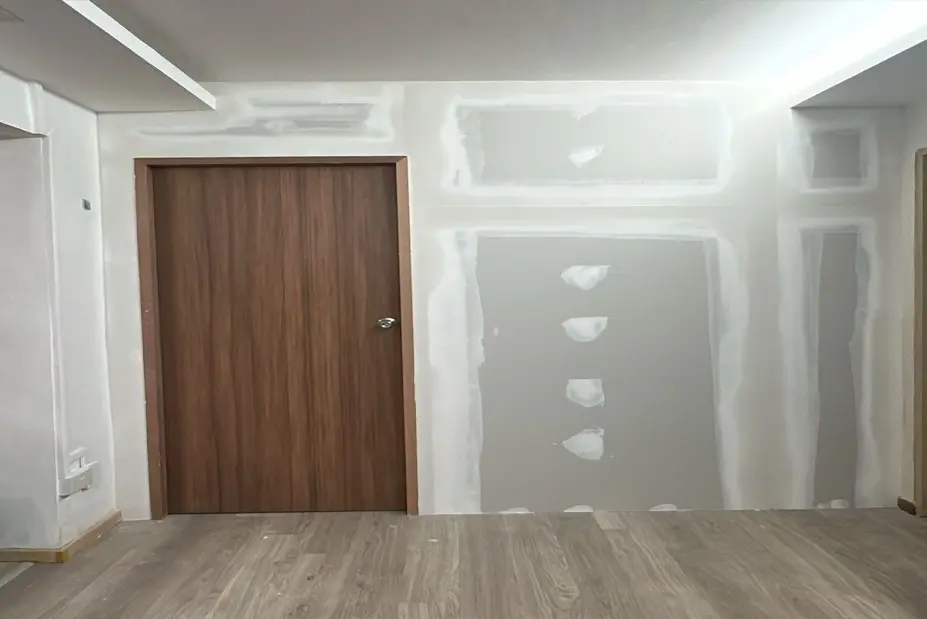
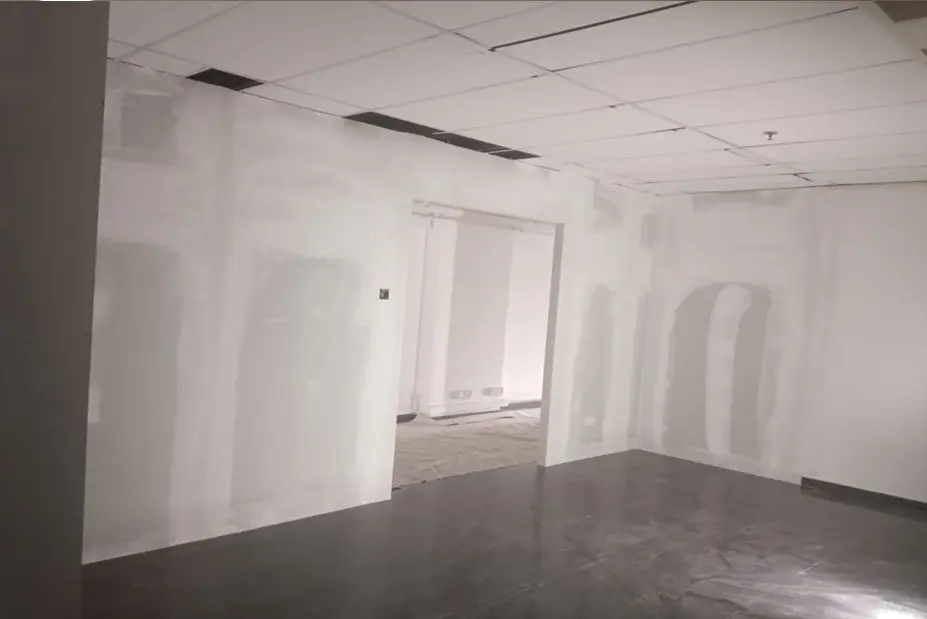
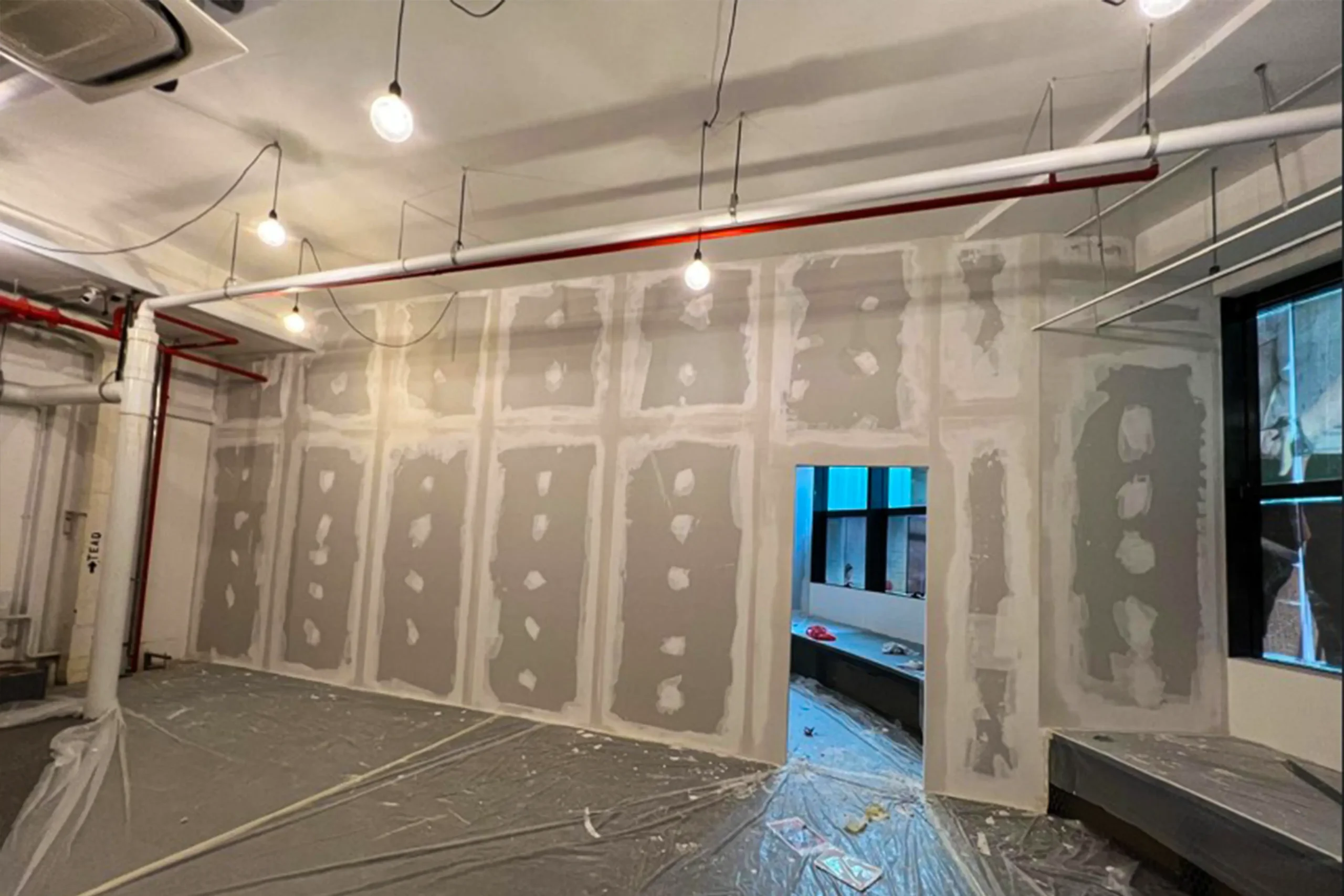
Your 4-room HDB flat is roughly 90 sqm. Your condo’s spare room is barely big enough for a desk. You need one more bedroom, a home office, or a quiet corner — without three weeks of hacking, dust, and permit headaches. This is exactly the problem a drywall partition solves.
Drywall Partition Singapore homeowners increasingly choose is a lightweight, non-structural wall built from galvanized steel framing clad in gypsum board. It goes up in days, not weeks, adds almost no load to your slab, and can be reconfigured or removed later without touching a single brick.
Quick Answer: A drywall partition in Singapore typically costs SGD 25–80 per square foot (SGD 270–860 per sqm) depending on whether it is standard, acoustic, moisture-resistant, or fire-rated. Installation takes 3–7 days for a single wall. Most non-structural partitions do not require an HDB permit, provided they avoid structural elements, escape routes, and required ventilation.
Below, we break down exactly what a drywall partition is made of, what a drywall partition Singapore project costs in 2026, when HDB approval applies, how to soundproof it properly, and how to hire a contractor who will not leave you with a wall that flexes when you lean on it.
A drywall partition looks like a solid wall once finished, but it is built in distinct, engineered layers. This is the anatomy every drywall partition Singapore installer should follow, and understanding the build-up matters because it is exactly where cheap contractors cut corners.
The skeleton of the wall is a galvanized steel frame: a horizontal track fixed to the floor and ceiling, with vertical studs slotted in between. Studs are typically spaced at 400mm or 600mm centres — 400mm centres give a stiffer, more solid-feeling wall, worth the extra cost if you are hanging heavy items. The frame carries the wall’s structural integrity, not the board, so a good frame is the difference between a wall that feels solid and one that visibly flexes when pushed.
Before boarding closes the cavity, this is your one window to conceal services inside the wall — electrical wiring, data/LAN cabling, TV points, and even small-bore piping. Confirm every socket, switch, and data point location before boarding starts, since adding a point afterward means cutting into a finished wall.
The visible wall is plasterboard, standard 12mm thickness (15mm for higher-spec or fire-rated applications), screwed onto both sides of the steel frame. Single boarding (one layer per side) suits a basic room divider, while double boarding (two layers per side) adds mass that significantly improves sound insulation and impact resistance. Board type varies by function: standard board for dry areas, moisture-resistant “green board” near kitchens or wet zones, and fire-rated board where compartmentation is required.
This finishing sequence turns visible screw heads and board joints into a seamless wall: taping and jointing to cover seams, a thin skim coat to smooth the surface, sanding between coats, then priming and painting. Skipping or rushing this stage is the single most common reason a “finished” drywall partition looks obviously fake under angled light.
Pricing for a drywall partition Singapore project varies by scope, board configuration, and finishing level. Here is a realistic 2026 range based on current Singapore contractor rates for supply and installation.
| Type | Cost (SGD per sq ft) | Cost (SGD per sqm) | Best Use Cases |
|---|---|---|---|
| Standard Drywall (single board, 12mm) | $25 – $45 | $270 – $480 | HDB common room split, store room, WFH corner |
| Acoustic / Soundproof (double board + Rockwool) | $45 – $75 | $480 – $810 | Bedroom next to living hall, office meeting room |
| Moisture-Resistant (green board core) | $35 – $55 | $380 – $590 | Kitchen backing, wet-area/yard-facing wall |
| Fire-Rated (1-hour rating) | $50 – $80 | $540 – $860 | Commercial office corridors, riser enclosures |
What moves the price within each range: a door and door frame adds roughly $250–$600 per opening; 400mm stud spacing (versus 600mm) gives a stiffer wall at extra cost; ceiling height and total wall length matter since cost is quoted per square foot of wall face; and finishing level — a skim-and-paint finish costs more than a taped-only finish left for wallpaper.
Illustrative example: An 8ft (H) × 10ft (L) standard drywall partition (80 sq ft of wall face) for an HDB common room split typically lands around SGD 2,000–3,600 including a basic door opening, before paint.
Brick or hollow-block “wet wall” construction used to be the default for a new room divider. In 2026, a drywall partition Singapore homeowners and office planners specify has overtaken brick for most residential and commercial reconfiguration work, for four concrete reasons.
| Pillar | Drywall Partition | Brick / Concrete Wall |
|---|---|---|
| Installation speed | 3–7 days | 2–3+ weeks |
| Slab load | Low | High |
| Cost per sq ft | Lower | Higher |
| Reconfigurable later | Yes, easily | Difficult, costly |
| Acoustic performance (base spec) | Moderate (upgradable) | Moderate–good |
| Wet works / mess | None | Significant |
Installation speed: Drywall is dry work — no cement mixing, no curing time, no days of dust settling into every corner of your flat. Weight load on HDB slabs: a drywall partition weighs a fraction of a brick wall, placing negligible additional dead load on the structural slab. Cost and flexibility: drywall is cheaper per square foot in almost every scenario and, critically, reversible if your needs change in five years. Acoustic and thermal control: a plain brick wall is not automatically quieter — a double-boarded drywall partition with Rockwool insulation can match or exceed a basic brick wall’s sound performance while adding thermal insulation brick does not offer.
Soundproofing is one of the most requested upgrades for any drywall partition Singapore project, closely followed by strong backing for mounted furniture and electronics.
Sound Transmission Class (STC) measures how well a wall blocks airborne sound. A standard single-layer drywall partition typically achieves an STC in the mid-30s to low-40s — fine for a store room but noticeable for a bedroom or meeting room. To push STC into the 45–55 range: fill the stud cavity with Rockwool or acoustic mineral wool insulation (the single highest-impact upgrade); add double-layer boarding on one or both faces; seal all perimeter joints with acoustic sealant, since sound leaks through gaps far more than through the board itself; and use solid-core doors with proper seals, because a hollow-core door undoes most of the wall’s acoustic upgrade.
Standard 12mm plasterboard alone will not securely hold a wall-mounted TV, floating kitchen cabinets, or a heavy mirror. Timber blocking (backing) — solid timber noggins or plywood strips installed inside the stud cavity at the exact mounting height — must be planned before boarding closes the wall. Tell your contractor upfront: TV wall mount location and size, kitchen cabinet runs, and any heavy mirror or shelving positions, since retrofitting backing into a finished wall means cutting it open.
Compliance is where a drywall partition Singapore project can stall if it is not planned correctly. Here is what to check before work starts.
Generally, no permit is required for a new, free-standing, non-structural drywall partition that does not touch structural elements or hack any existing wall or floor, provided you use a licensed/registered renovation contractor. A permit is required for hacking or demolishing any existing internal wall (HDB must first confirm it is non-structural) or work that alters structural reinforced concrete elements. Hacking structural RC columns, beams, or load-bearing walls is never permitted. Electrical works — new points, rewiring, or relocated switches — must be carried out by a licensed electrical worker and are regulated separately. Always verify your specific flat and scope via HDB’s official renovation guidelines before committing to a layout.
A new partition cannot obstruct a required means of escape, such as sealing off the only route from a bedroom to the front door. Newly enclosed rooms generally need adequate ventilation — an operable window or mechanical ventilation — since a fully sealed windowless box is a red flag most contractors and MCSTs will push back on.
Private condos don’t fall under HDB rules, but almost every Management Corporation Strata Title (MCST) requires renovation approval before work starts, plus a refundable renovation deposit. This paperwork applies to a drywall partition Singapore condo owners install just as much as any other renovation item, and structural changes, even minor ones, may still require the developer’s or a qualified Professional Engineer’s endorsement.
Commercial office fit-outs are subject to Singapore Civil Defence Force (SCDF) fire safety requirements, which is where fire-rated drywall partitions become relevant rather than optional. Partitions enclosing fire escape staircases, lift lobbies, or riser/electrical switch rooms typically require a minimum fire-rating (commonly 1-hour), using certified fire-rated board and compliant door sets.
Choosing the right drywall partition Singapore contractor makes the difference between a wall that lasts decades and one that cracks within a year. Use this checklist before signing off.
Yes, but only if timber or plywood backing was installed inside the stud cavity at the mounting location before the wall was boarded. Standard plasterboard alone cannot safely hold a wall-mounted TV.
In most cases, a new non-structural drywall partition does not require an HDB permit, but you still need a licensed/registered renovation contractor, and the layout must not block escape routes or seal off required ventilation.
A standard single-layer partition offers moderate sound reduction (STC roughly mid-30s to low-40s). For bedrooms or meeting rooms, upgrade to double-layer boarding with Rockwool insulation to reach STC 45–55.
A single standard partition typically takes 3–7 days from framing to final coat, plus extra days for painting, a door installation, or new electrical points.
Yes, provided moisture-resistant “green board” drywall is used instead of standard board, and the partition is not in direct, sustained contact with water.
Yes — this is one of its core advantages over brick. Removal involves unscrewing boards, dismantling the steel frame, and patching the floor/ceiling/adjacent wall junctions.
Whether you are splitting an HDB common room, adding a home office in a condo, or fitting out a commercial floor plate, a well-specified drywall partition Singapore contractors install correctly will serve you for years without the mess, cost, or permit complexity of a brick wall.

Nextech Design Engineering Pte Ltd
WhatsApp us